
Collaborative research · Shared first author
Coarsening molecular graphs around functional groups.
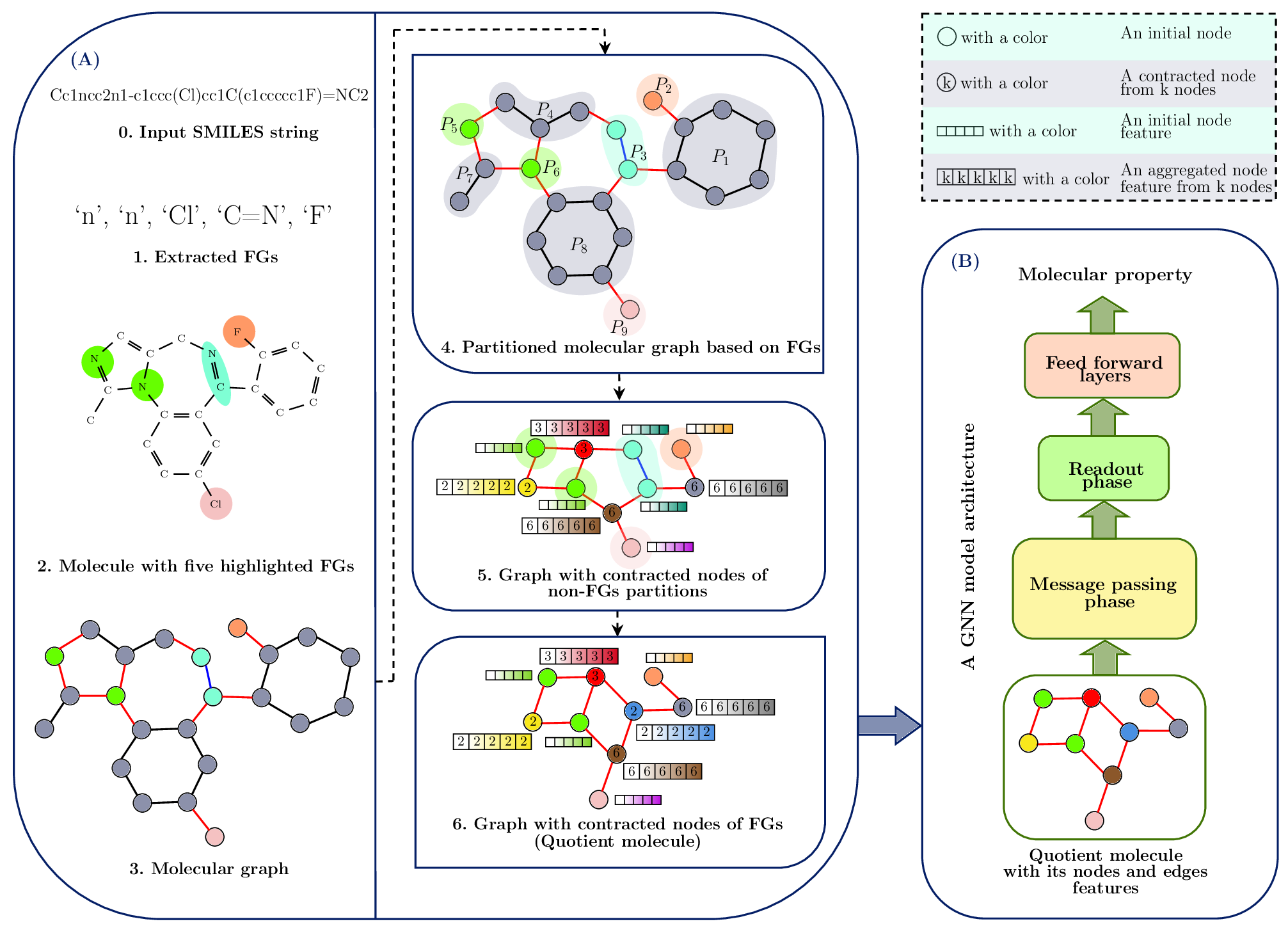
FunQG uses a quotient-graph perspective to build smaller molecular representations from functional groups, then evaluates those representations with graph neural networks for molecular property prediction.
Read the published FunQG paper ↗
Research question
Can a molecular graph be simplified into a smaller, more informative graph that supports molecular-property prediction while reducing the depth and computational burden associated with message passing on the original graph?
The published work motivates this through known difficulties in deeper GNNs, including over-smoothing and over-squashing, and the cost of larger parameterized models.
Method
FunQG uses functional groups as meaningful molecular building blocks. The repository describes a pipeline that extracts functional groups, partitions molecular graphs, generates quotient/coarsened graphs, and trains GNN models for prediction. The code includes graph generation, training/evaluation, and hyperparameter-tuning entrypoints, with molecular-property datasets and scaffold/random splitting options documented.
I developed, trained, benchmarked, and evaluated graph-based ML models, including work on FunQG. This is collaborative research; shared first authorship does not imply sole ownership of the code or results.
Published findings
The article reports that the resulting molecular quotient graphs are substantially smaller than the original molecular graphs, and that experiments across molecular-property prediction benchmarks produce notable prediction results while reducing model parameters and computational costs. Results vary across the reported tasks and experimental settings; see the paper for benchmark-specific results.
The publication compares GNN baselines on the coarsened datasets with state-of-the-art baselines on the original datasets. The implementation README describes evaluation on datasets including Tox21, BBBP, BACE, SIDER, ESOL, FreeSolv, HIV, QM7/QM8, and PDBbind tasks.
Research scope
The evidence describes molecular-property prediction benchmarks and a functional-group-based graph-coarsening method. The portfolio does not generalize these findings to unrelated graph tasks or production systems. Exact benchmark outcomes depend on the paper’s dataset, split, baseline, and training setup; consult the article and supporting information for details.
This was collaborative research. My CV records shared first authorship and direct work on model development, training, benchmarking, and evaluation.
Publication & code
Hajiabolhassan, H.; Taheri, Z.; Hojatnia, A.; Yeganeh, Y. T. “FunQG: Molecular Representation Learning via Quotient Graphs.” Journal of Chemical Information and Modeling 2023, 63(11), 3275–3287. DOI: 10.1021/acs.jcim.3c00445 ↗
Collaborative code repository ↗ · ACS article record ↗ · 2022 preprint ↗
The arXiv link is the earlier preprint; the citation above refers to the final 2023 journal article.